Sunday, July 30, 2006
Radio Mix Checks in From Ukraine
Last week I blogged about a wonderful experience discussing radio programming strategies with three visitors from Ukraine. It was a nice surprise when I actually heard back from them via email a few days ago. Someone named "Sandra" from Radio Mix emailed me on behalf of Olena Kotova, Vyacheslav Ibryaev and Dmitriy Zapashikov. And, I knew that they had read the blog...because they informed me that the interpreters' names were Julia and Ismail! ;}


Wednesday, July 26, 2006
Undergrads' Enthusiasm Sparked Every Day
A lot of my blogging is about graduate students...the work they are doing in the ICR, etc. But its always great to remind myself of just how many outstanding undergrads we have here as well.
Case in point...about two weeks ago the faculty received an email from Legene White, our Director of Alumni Relations, telling us that the IU Alumni Association (IUAA) had adopted the Flash programming work of one of our undergrads--Leigh Boje--for the opening page of the Homecoming Website.
Originally, I was going to blog about it...include a link to it (here it is) and just say "Hooray Leigh".
But, then I emailed Legene to share the idea with her and hopefully find out more about Leigh.
Legene said "why don't you email her and ask her about her impressions on the department."
I did, and here's the reply she sent:
And, Leigh's responses show how enthusiams for creation and learning are sparked every semester here in IU Telecomm.
Case in point...about two weeks ago the faculty received an email from Legene White, our Director of Alumni Relations, telling us that the IU Alumni Association (IUAA) had adopted the Flash programming work of one of our undergrads--Leigh Boje--for the opening page of the Homecoming Website.
Originally, I was going to blog about it...include a link to it (here it is) and just say "Hooray Leigh".
But, then I emailed Legene to share the idea with her and hopefully find out more about Leigh.
Legene said "why don't you email her and ask her about her impressions on the department."
I did, and here's the reply she sent:
- I getting ready for my last year at IU and I guess my offical focus in Telecom is Design and Production, but I've taken lots of Industry and Management classes and a couple Media and Society.
I got interested in web design after taking Norbert Herber's T284(Intro to Interactive Media) class. I then took his T361(Interactive Transmedia Design) class learning Flash and that is what led to this opportunity for me. I also created the new MultiVisions website this past spring using what Norbert has taught me.
I've learned a lot about computers since I've been in college. I've taken Java programming classes through the Computer Science department, I researched on my own and built my own computer "from scratch", and now I will be learning about more web scripts when I take A348(Computer Science class, Mastering the World Wide Web).
I really enjoy interactive media, especially the web and video games, and hope to have a job in either eventually.
And, Leigh's responses show how enthusiams for creation and learning are sparked every semester here in IU Telecomm.
Sunday, July 23, 2006
Consulting INTERNATIONAL Radio Broadcasters!
Last week I had a wonderful time talking about radio programming strategies--something that I have not been able to talk with someone about for several years at least. Oh, I've taught programming strategies almost every semester for the past 8 years or so...and therefore I've taught the basics to my undergraduates. Unfortunately, in that situation, most of the knowledge is going in one direction. But several days ago I was able to have an in-depth conversation with a Program Director and Disc Jockey who wanted my opinions on strategies they had been considering for an upcoming format change and the accompanying marketing campaign. Usually, I am somewhat cautious about consulting stations that are located nearby the university I work for--because I want to remain impartial and friendly with all my "corporate neighbors". There was very little reason for me to be concerned in this case, however, because the professionals I consulted with were from Radio Mix in
And now, apparently it was WFIU’s turn to return the favor. Several weeks ago I received an e-mail from a station representative, asking me if I wanted to meet with the Radio Mix staff to talk about programming strategies and marketing approaches. I was certainly interested—not only to talk about these issues--but also to have the experience of holding a conversation entirely through interpreters -- as the three people coming from
As the meeting approached, however, I became more concerned about our ability to truly communicate to one another about the intricacies involved in radio programming and marketing. Turns out I should not have been worried. On Monday the 10th I met with Dmitry Zapachshikov, Olena Kotova, and Vyacheslav Ibryaev in a studio in the WFIU facilities. There were two interpreters there (who I’m sorry, I did not get the names of…but to whom I’m very grateful as this experience would have been impossible without them).
The first meeting was 90 minutes long. They wanted to know ways in which I would suggest they market their contemporary formatted music station in their city of over a million people. Although I had read the article from Directions in Sound I had the impression that the radio market was not that competitive. It turns out, that was mistaken, as there are more than 30 stations in the market, and Radio Mix is one of five or so targeting what they called “the 20-35 year old market.”
The first 20 minutes or so were spent with me asking them questions about the market. To give advice without at least trying to understand the specific competitive nuances would not have been good. And, although I still think that some was “lost in translation”, a key element was that their primary competitors in town were all satellite delivered, national formats. Radio Mix was the only station targeting 20-35s that was programmed locally and had local air talent. This similarity to the American radio broadcast industry was interesting -- in fact, a Bloomington/Indianapolis station WTTS has recently been running imaging spots--Obviously targeted toward ClearChannel and other large corporate owners—saying “We’ve been owned by the same man of 30 years…and He’s from Indiana, too.” Or something like that.
So, my first advice to them was to emphasize the fact that they are local and proud to be local. As an interesting side note, the concept of being “proud to be local” originally got translated as "patriotic". To whichVyacheslav responded that not many of the city’s citizens felt all that patriotic toward the city. I stressed that patriotism was not what I was talking about, but rather the station needed to communicate to its audience that they were there, living in Dnepropetrovsk—going to the same clubs they did, aware of what they did on the weekends…and as much as possible having the station be seen at those same places. Since they didn’t have a budget for music research (and their format is CHR…but draws music from all across Europe and the
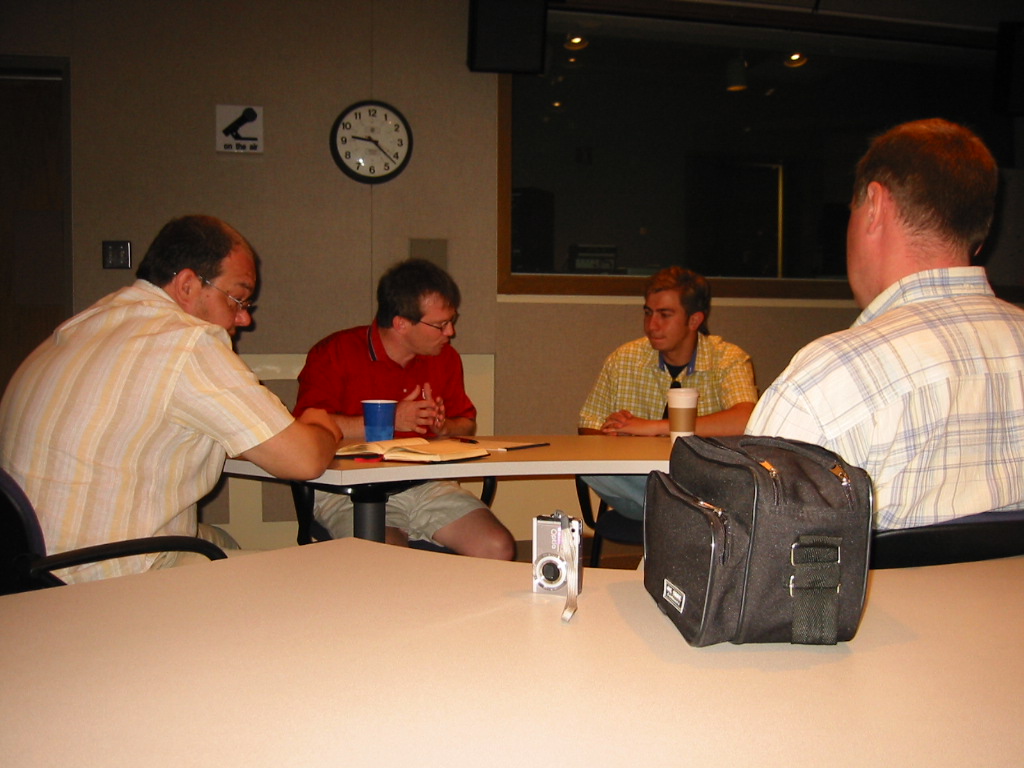
Here I am at the first meeting with the group from Radio Mix. Of course, the picture shows a great shot of me and the interpreter. And the BACKS of Dmitry Zapachshikov (left) and Vyacheslav Ibryaev (right).
I was really enthused by our first meeting -- and disappointed when it HAD to come to an end because I had my T340 course to teach. Luckily, they found time in their schedule to meet with me again later in the week. This time, I learned that Radio Mix—although currently targeting 20-35—was actually considering focusing their target to 18-24. So, at the second meeting Vyacheslav and Olena and I discussed my recommendations on a number of things concerning the upcoming change. The first thing they wanted to know was whether they needed to change their logo. Apparently, the term “Radio Mix” was set in stone, as in
We talked about hot clocks, and rotations, and jingles and stopsets. All through the interpreters. It was an amazing experience—one which I am very grateful that I was able to be involved in.

Here we are at the second meeting. Vyacheslav and I talking music rotations with the help of one of the interpreters (darn I wish I had written their names down!).

And there, on the left, is Olena Kotova who is an air talent at Radio Mix
I wish them luck and hope that our conversations were as useful to them as they were enjoyable to me.
Monday, July 17, 2006
Three Doctors All in a Row!

It has been terribly long since my last posting. Often, when this happens it is because I don't know what to blog about. Right now, though, I'm BACKED UP with topics I'd like to share with you about really exciting things that are happening in the IU Dept. of Telecommunications.
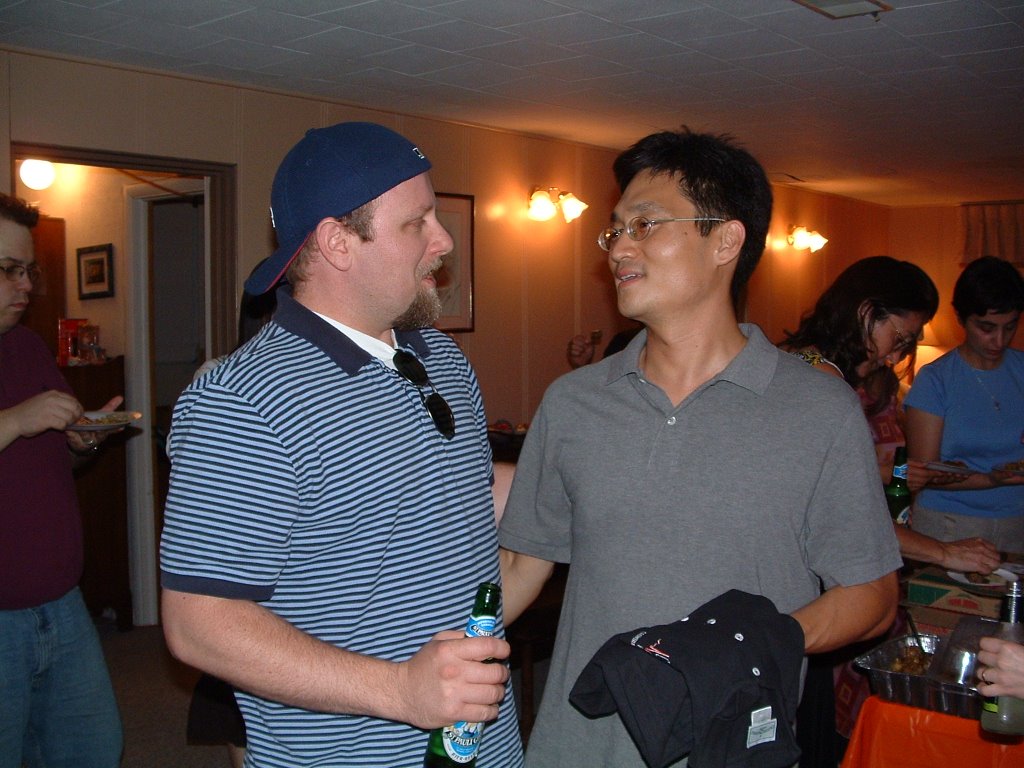
Let's get caught up by congratulating two more Ph.D. recipients. The picture above was taken at a celebration party on Friday night. The man in the middle is Byungho Park, who I congratulated below. Then, things got busy...with Chen-Chao (the man on the left) and Mija Shin (on the right) defending their dissertations in two successive days!
First came Mija, whose dissertation was entitled "THE ROLE OF MOTIVATION ACTIVATION, POSITIVITY OFFSET AND NEGATIVITY BIAS IN PROCESSING EMOTIONAL MEDIA MESSAGES". Again, I would do it injustice if I tried to explain it in this little space. I would say, however, that it certainly helped to move the theoretical approach to embodied cognitive response to media forward. I encourage those interested to contact Mija directly. She is an Assitant Professor at the Murrow School of Communications at Washington State University. Growing up in Washington State myself (about 2 hours from WSU in a town called Richland) I have a special connection to the Murrow School and am at times envious of Mija...a quick look around Bloomington and the IU campus usually solves that, though! :)
The next day, Chen-Chao defended his dissertation entitled: "COGNITIVE PROCESSING DURING WEB SEARCH: THE ROLE OF WORKING MEMORY LOAD IN SELECTIVE ATTENTION AND INHIBITORY CONTROL". As a reader (and committee member) I liked Chen-Chao's dissertation for several reasons. First, it was very applicable to industry questions. Search engines like Google are searching for ways to make paide search more effective for their customers, and Chen-Chao approaches this question with a focused experiment. Secondly, the theoretical basis for his work was a working-memory theory of attention...which is a different approach than the limited-capacity theory under which I conduct my work. It was very interesting to read a series of well-constructed hypotheses based upon a different point of view. Again, I'll let you contact Chen-Chao directly to find out more about his study and the results. Chen-Chao also has an Assistant Professor position at National Chiao Tung University in Taiwan.
Congratulations to both of them...and again to Byungho who is seen below offering advice to Johnny Sparks, the next doctoral candidate in line to defend--sometime in mid-August.
Friday, July 07, 2006
Congratulations to Dr. Byungho Park
This bit of congratulations is a few days late...but on Wednesday Byungho Park successfully defended his doctoral dissertation in Mass Communications. Byungho was one of the first grad students I was introduced to when I joined the faculty at IU and I have seen him grow very much as a scholar. His interest in computer games and interactive design first brought him to IU for the Masters in Immersive Media Environments (MIME) program. However, his interest soon moved more toward testing theoretica-driven predictions about how people cognitively process and emotionally respond to games. As a result, he joined the Ph.D. program.
Byungho's interest in games still continues, however. Here's the title of his dissertation:
Video Game Play and Motivation:
Variation in Appetitive and Aversive Motivational System Activation as a Function of Virtual Threat Level
Byungho has also been the ICR Manager for the past year--as such he as helped me tremendously to keep the very busy facility running smoothly. I will miss him very much in that regard and want to thank him for his work.
I also wish him well as he joins the faculty of National University in Singapore in the Communication and New Media Programme this fall.
Byungho's interest in games still continues, however. Here's the title of his dissertation:
Video Game Play and Motivation:
Variation in Appetitive and Aversive Motivational System Activation as a Function of Virtual Threat Level
Byungho has also been the ICR Manager for the past year--as such he as helped me tremendously to keep the very busy facility running smoothly. I will miss him very much in that regard and want to thank him for his work.
I also wish him well as he joins the faculty of National University in Singapore in the Communication and New Media Programme this fall.
Thursday, July 06, 2006
Strange how the mind works with words
Here's an interesting email I received today...
See if you can read this:
----------------------------------------------
fi yuo cna raed tihs, yuo hvae a sgtrane mnid too
Cna yuo raed tihs? **Mnay** **plepoe** can.
i cdnuolt blveiee taht I cluod aulaclty uesdnatnrd waht I was
rdanieg. The phaonmneal pweor of the hmuan mnid, aoccdrnig to a
rscheearch at Cmabrigde Uinervtisy, it dseno't mtaetr in waht oerdr
the ltteres in a wrod are, the olny iproamtnt tihng is taht the
frsit and lsat ltteer be in the rghit pclae. The rset can be a taotl
mses and you can sitll raed it whotuit a pboerlm. Tihs is bcuseae
the huamn mnid deos not raed ervey lteter by istlef, but the wrod as
a wlohe. Azanmig huh? yaeh and I awlyas tghuhot slpeling was
ipmorantt!
--------------------------------
Any students in my classes...don't think this is an open invitation to ignore proofreading your papers!!
See if you can read this:
----------------------------------------------
fi yuo cna raed tihs, yuo hvae a sgtrane mnid too
Cna yuo raed tihs? **Mnay** **plepoe** can.
i cdnuolt blveiee taht I cluod aulaclty uesdnatnrd waht I was
rdanieg. The phaonmneal pweor of the hmuan mnid, aoccdrnig to a
rscheearch at Cmabrigde Uinervtisy, it dseno't mtaetr in waht oerdr
the ltteres in a wrod are, the olny iproamtnt tihng is taht the
frsit and lsat ltteer be in the rghit pclae. The rset can be a taotl
mses and you can sitll raed it whotuit a pboerlm. Tihs is bcuseae
the huamn mnid deos not raed ervey lteter by istlef, but the wrod as
a wlohe. Azanmig huh? yaeh and I awlyas tghuhot slpeling was
ipmorantt!
--------------------------------
Any students in my classes...don't think this is an open invitation to ignore proofreading your papers!!
Sunday, July 02, 2006
Better written ads lead to more arousal
Where does the time go?
Almost 2 Weeks Ago I began talking about some research I've done with Seth Finn and Sungkyoung Lee. In that post, I told you that I would return to the topic the next day. Like I say, it's been 2 weeks!
Well, here we go...
My research focuses on how structural features of audio messages can cause listeners to have automatic attention responses to the message. So, for example, some of my earlier work shows that when one speaker's voice is replaced by another's, listeners automatically allocate more attention to that change in the auditory stream. This is a quick enhancement of processing, you understand...only lasting a few seconds...in which the contentof the message would need to be interesting in order for the listener to continuepaying controlled attention to it.
A couple of years ago, one of my graduate students, Sungkyoung, became interested in investigating whether merely including an emotional word in an audio presentation will cause listeners to automatically allocate more attention to the presentation for a few seconds.
As part of doing so, she collected physiology from research subjects while they listened to radio ads containing nothing but spoken words (i.e., no music, no sound effects, etc.).
Then, along came Seth Finn who has long been interested in how unpredictability of words used in written texts lead to more favorable responses in readers, like self-reported enjoyment. He has used a data-collection technique called the cloze procedure--which quantifies the predictability of each word in a text. However, while most cloze analyses quantify the mean predictability of a text OVERALL, Seth has analyzed content words and structure words separately. As an example, consider the sentence: I want to eat cherry pie and vanilla ice cream for my birthday. Content words would include: I, want, eat, cherry, pie, vanilla, ice, cream, my & birthday. "To", "And" & "For" are structure words.
Seth has tested and confirmed hypotheses that effective writing contains highly predictable structure words and highly unpredictable content words. In other words, when a content word contains more INFORMATION VALUE, it leads to more enjoyment in readers. He has also shown that the relative information value of content words was related to self-reported arousal:
So, as I mentioned earlier, Seth and I got together several years ago and began thinking that if high-information content words are associated with higher enjoyment...and this enjoyment is due (in part) to readers being more aroused by the unpredictability...could the same higher arousal be exhibited in listeners when exposed to audio information that varies in it's predictability?
To test this question, here's what we did:
We took skin conductance data from four of the radio messages that Sungkyoung had played for her subjects. As is usually done, we measured skin conductance on the palms of the hands, where the sweat glands respond not to how hot the body is, but rather how aroused the person is. The four messages we used were the ones which showed the most variation in skin conductance across the entire 60 second ad--because remember we were looking for variance which we could correlate with the amount of information value. We then calculated how the skin conductance changed at each second (t) from each second just before it (t - 1).
Then, Seth created cloze procedure instruments for each of the adds. Here's a partial example:

Each script had eight different cloze scripts: where every 8th word was replaced by a blank, the intial replaced word was rotated across the 8 versions, and 18 subjects completed each version.
Then, an information-value score was created for every content word and every function word. We then calculated how the listeners' arousal (skin conductance change scores) correlated with the information-value scores.
As we suspected, there was no correlation at all between function words (i.e., to, and, and for) and information value. However, when we correlated the arousal with the information of the content words (eat, vanilla, and birthday) we found a positive correlation. You can see it for one of the messages below:
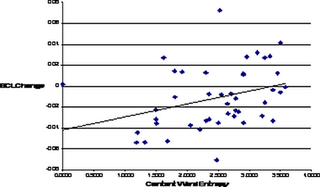
Now, the other three messages showed similar positive correlations. As the information-value of each individual word increased, so did the physiological arousal reaction. This--once again--shows that words are important and shouldn't be chosen lightly in audio production.
More information about this research study will be presented at the Society for Psychophysiological Research conference in October.
Almost 2 Weeks Ago I began talking about some research I've done with Seth Finn and Sungkyoung Lee. In that post, I told you that I would return to the topic the next day. Like I say, it's been 2 weeks!
Well, here we go...
My research focuses on how structural features of audio messages can cause listeners to have automatic attention responses to the message. So, for example, some of my earlier work shows that when one speaker's voice is replaced by another's, listeners automatically allocate more attention to that change in the auditory stream. This is a quick enhancement of processing, you understand...only lasting a few seconds...in which the contentof the message would need to be interesting in order for the listener to continuepaying controlled attention to it.
A couple of years ago, one of my graduate students, Sungkyoung, became interested in investigating whether merely including an emotional word in an audio presentation will cause listeners to automatically allocate more attention to the presentation for a few seconds.
As part of doing so, she collected physiology from research subjects while they listened to radio ads containing nothing but spoken words (i.e., no music, no sound effects, etc.).
Then, along came Seth Finn who has long been interested in how unpredictability of words used in written texts lead to more favorable responses in readers, like self-reported enjoyment. He has used a data-collection technique called the cloze procedure--which quantifies the predictability of each word in a text. However, while most cloze analyses quantify the mean predictability of a text OVERALL, Seth has analyzed content words and structure words separately. As an example, consider the sentence: I want to eat cherry pie and vanilla ice cream for my birthday. Content words would include: I, want, eat, cherry, pie, vanilla, ice, cream, my & birthday. "To", "And" & "For" are structure words.
Seth has tested and confirmed hypotheses that effective writing contains highly predictable structure words and highly unpredictable content words. In other words, when a content word contains more INFORMATION VALUE, it leads to more enjoyment in readers. He has also shown that the relative information value of content words was related to self-reported arousal:
- Donohew, L., Finn, S., & Christ, W. (1988). The nature of news revisited: The roles of affect, schemas and cognition. In H. E. Sypher, L. Donohew, & E. T. Higgins (Eds.), Communication, social cognition, and affect (pp. 195-218).
So, as I mentioned earlier, Seth and I got together several years ago and began thinking that if high-information content words are associated with higher enjoyment...and this enjoyment is due (in part) to readers being more aroused by the unpredictability...could the same higher arousal be exhibited in listeners when exposed to audio information that varies in it's predictability?
To test this question, here's what we did:
We took skin conductance data from four of the radio messages that Sungkyoung had played for her subjects. As is usually done, we measured skin conductance on the palms of the hands, where the sweat glands respond not to how hot the body is, but rather how aroused the person is. The four messages we used were the ones which showed the most variation in skin conductance across the entire 60 second ad--because remember we were looking for variance which we could correlate with the amount of information value. We then calculated how the skin conductance changed at each second (t) from each second just before it (t - 1).
Then, Seth created cloze procedure instruments for each of the adds. Here's a partial example:

Each script had eight different cloze scripts: where every 8th word was replaced by a blank, the intial replaced word was rotated across the 8 versions, and 18 subjects completed each version.
Then, an information-value score was created for every content word and every function word. We then calculated how the listeners' arousal (skin conductance change scores) correlated with the information-value scores.
As we suspected, there was no correlation at all between function words (i.e., to, and, and for) and information value. However, when we correlated the arousal with the information of the content words (eat, vanilla, and birthday) we found a positive correlation. You can see it for one of the messages below:
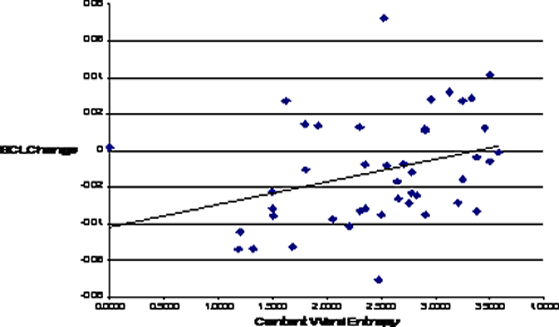
Now, the other three messages showed similar positive correlations. As the information-value of each individual word increased, so did the physiological arousal reaction. This--once again--shows that words are important and shouldn't be chosen lightly in audio production.
More information about this research study will be presented at the Society for Psychophysiological Research conference in October.
Subscribe to:
Posts (Atom)


 Posts
Posts


