Summertime is traditionally a HUGE advertising season for radio stations.
This only makes sense--as radio's portability makes it a natural for people to take with them to the park, the beach, the pool, and crank up in the car while cruising.
Only trouble is...in a 30-second advertising model this leads to HUGE commercial clutter during the summer months. In today's world, listeners get upset and head for their ipods.
What's broadcast radio to do?
Well, check out this story about WFNX in Boston.
The station still needs the revenue. But by piecing it all together selling jillions of ad units, it shoots itself in the foot. So, get ONE SPONSOR to basically be the Brand sponsor for the entire summer months.
WFNX is getting $2 million from Snapple to brandcast from Memorial Day through July 4th.
They will have Snapple mentions included as part of music bumpers, production effects, and live announcer reads.
But, as far as commercials are concerned THAT'S IT. For 40 consecutive days!
Really attractive to listeners.
No clutter for Snapple to worry about.
Great idea.
Friday, May 26, 2006


Friday, May 19, 2006
The First Olive Outta the Bottle?
My dad uses the saying "the first olive outta the bottle is the toughest" to explain how hard it is to convince the first person in a group to make a change/commit to a project/etc.
Arbitron Corporation may be breathing a sigh of relief this morning as they have gotten their first olive out in terms of a corporate commitment to their Portable People Meter (PPM) ratings service.
In a story from Radio and Records, CBS-Radio--the nation's second-largest group owner with 179 stations in mostly Top 50 markets--has agreed to a seven year deal with Arbitron to use the electronically gathered ratings data in their advertising negotiations.
Read the R&R article here
Read a press release from CBS Radio here.
Arbitron Corporation may be breathing a sigh of relief this morning as they have gotten their first olive out in terms of a corporate commitment to their Portable People Meter (PPM) ratings service.
In a story from Radio and Records, CBS-Radio--the nation's second-largest group owner with 179 stations in mostly Top 50 markets--has agreed to a seven year deal with Arbitron to use the electronically gathered ratings data in their advertising negotiations.
Read the R&R article here
Read a press release from CBS Radio here.
Wednesday, May 17, 2006
Book project moving forward
My colleague, Paul Bolls and I have been toying with the idea of writing a book on psychophysiological measures and their implications for mass communications research for a long time now. I mean, a long time. We started talking about doing this almost 5 years ago, I think.
Then, last November we finally came to the realization that trying to write the darn thing long-distance (with him running the PRIME LAB at Missouri School of Journalism) and me here at IU. So, we met half-way in between in a small town called Mt. Vernon Illinois. There we worked for a whole weekend on the outline of the book, addressing the likely audience, the competition, etc. This we submitted to a publisher around the beginning of the year.
Well, a few weeks ago we received a pair of reviews back from the publisher. As always, the reviews were insightful and both recommended that the publisher accept our proposal...after revisions, of course. Unlike many reviews I've received, they never took a nasty turn.
Today, Paul and I talked on the phone about changes we think we'll make in response to the reviewers. Then, next week we'll have a phone call with the Senior Acquisitions Editor at the publisher.
Nice to move this project forward.
Then, last November we finally came to the realization that trying to write the darn thing long-distance (with him running the PRIME LAB at Missouri School of Journalism) and me here at IU. So, we met half-way in between in a small town called Mt. Vernon Illinois. There we worked for a whole weekend on the outline of the book, addressing the likely audience, the competition, etc. This we submitted to a publisher around the beginning of the year.
Well, a few weeks ago we received a pair of reviews back from the publisher. As always, the reviews were insightful and both recommended that the publisher accept our proposal...after revisions, of course. Unlike many reviews I've received, they never took a nasty turn.
Today, Paul and I talked on the phone about changes we think we'll make in response to the reviewers. Then, next week we'll have a phone call with the Senior Acquisitions Editor at the publisher.
Nice to move this project forward.
Tuesday, May 16, 2006
Advice for finishing the thesis/dissertation
Several of the students in the ICR are working feverishly on finishing the Masters theses or Doctorial dissertation. And, I'm hoping that some of them occassionally take a break from data analysis and writing to visit the blog. Just in case, here's a link to a good bit of advice from The Tomorrow's Professor blog...a forum created by MIT and Stanford to allow discussion of higher education issues, supposedly by those considering going into the academic profession.
Monday, May 15, 2006
Mistaken Identity
Thanks to my colleague, Ted Castronova who forwarded a few links to me and the other faculty in the Department of Telecommunications with an interesting story.
First, a little background:
We all know what Apple Computer's ipods are.
And how the Apple logo appears all over the place now.
Well, apparently Apple Corps.--the folks who own the Beatles' music-- had filed a lawsuit saying that Apple should not be allowed to use the logo. In the past few days the courts ruled against the Corps. This removes a major lega impediment to downloading of music via ipods/istores.
Now, I'm not an expert in copyright law (check out Matt Jackson, a friend of mine on the faculty of Penn State University if that's your interest). But, here's what interests me...
the BBC booked an appearance from Guy Kewney--an expert in the area of file sharing.
Unfortunately, in (perhaps) a rush to get info on the air, nobody in charge of getting Kewney on the set bothered to investigate what he looked like.
Instead, the BBC held an interview with a British cab driver...who supposedly had driven Kewney to the interview. Read the story here.
The cab driver was a GREAT sport. He looked absolutely petrified when introduced as Kewney (to a nation...and now international audience) but then answered all the questions...to the best of his knowledge.
You can see the interview here.
First, a little background:
We all know what Apple Computer's ipods are.
And how the Apple logo appears all over the place now.
Well, apparently Apple Corps.--the folks who own the Beatles' music-- had filed a lawsuit saying that Apple should not be allowed to use the logo. In the past few days the courts ruled against the Corps. This removes a major lega impediment to downloading of music via ipods/istores.
Now, I'm not an expert in copyright law (check out Matt Jackson, a friend of mine on the faculty of Penn State University if that's your interest). But, here's what interests me...
the BBC booked an appearance from Guy Kewney--an expert in the area of file sharing.
Unfortunately, in (perhaps) a rush to get info on the air, nobody in charge of getting Kewney on the set bothered to investigate what he looked like.
Instead, the BBC held an interview with a British cab driver...who supposedly had driven Kewney to the interview. Read the story here.
The cab driver was a GREAT sport. He looked absolutely petrified when introduced as Kewney (to a nation...and now international audience) but then answered all the questions...to the best of his knowledge.
You can see the interview here.
Friday, May 12, 2006
Gender Differences in Response to Sexual Lyrics
Okay, I have been feeling bad about the lack of posts focusing on actual research that's been going on in the lab. Last summer I was collecting data from an experiment investigating the impact of doubling the number of commercial units in a radio stopset without increasing the overall duration of the commercial break itself. (You can read more about that particular study and i's findings by reading this blog post.)
The stimuli for that experiment consisted of creating excerpts from two radio stations--using 8 actual popular songs from the CHR/Pop charts at the time. For those of you who are unaware of what goes into the typical experimental data collection session when physiological data are collected, the participant comes in and is exposed to the media individually. This is because they get fitted for electrodes to measure various physiological reactions. In other words,--as opposed to experiments where physiology aren't collected, and therefore groups of participants can be run at one time--in physiology data collection you have to play the stimuli for each participant...ONE AT A TIME.
That means that the experimenters who collect the data become very familiar with the stimuli. And that was the case with these "radio shows" and the eight songs. During the data collection, my two research assistants commented on the sexual content of the lyrics of two of the songs. Not only that, but the mentioned that the female research participants would seem to have have adverse physiological reactions while listening to these two songs.
That got us thinking of a secondary analysis we could do...investigating whether males and females responded to the songs differently. Severall months ago I announced this possibility in an ICR Lab meeting...but because we were all busy, nothing came of it at the time.
Then, the May 1 deadline for submissions to the Society for Psychophysiological Research rolled around. Two other graduate students, Pamela Gayle Nadorff and James Angelini, both of whom have an interest in gender-issues in media, reminded me of the analysis and asked if they could do it.
Sure, why not.
But, the more I started looking at the 8 songs we played to the participants the more I realized that there were actually 4 we could use to test a more elaborate question. Two of the songs were the original ones that caught our attention. They were sung by male rap singers and consisted of lyrics where women were presented as objects for the man's sexual satisfaction:
Balla Baby by Chingy
and
Get Back by Ludacris
Then, there were two of the songs that were song by female rappers and the lyrics focused on men as sex objects:
Lose my Breath by Destiny's Child
and
1,2, Step by Ciara
The two physiological measures we analyzed from 28 females and 18 males were corrugator muscle activity (basically how much their frown muscles were activated while listening) and their skin conductance responses (SCRs). SCRs are measured on the palms of the hands and basically indicate how arousing the subjects felt while the songs were playing.
And the results? Well, I have ALWAYS been one who listens to lyrics closely. And, I thought that most people focus on the beat of a song rather than the lyrics. But...just as we predicted...female listeners had more negative emotion during the songs where the lyrics portrayed women as sex objects. In the figure below, this is represented by the greater corrugator activity during the female-focused songs (blue line) compared to the male-focused songs (green line):
 And, although it is a less pronounced effect, we found greater frown activity in male listeners during songs when female rappers talk about using men as sex objects green line) compared to songs where men are talking about their sexual proclivity (blue line):
 The other interesting finding was that there was not a difference in arousal level according to the lyrics. That doesn't mean there wasn't an effect, though. Males, regardless of the gender-focus of the lyrics, had more skin conductance responses during the songs than females.
The stimuli for that experiment consisted of creating excerpts from two radio stations--using 8 actual popular songs from the CHR/Pop charts at the time. For those of you who are unaware of what goes into the typical experimental data collection session when physiological data are collected, the participant comes in and is exposed to the media individually. This is because they get fitted for electrodes to measure various physiological reactions. In other words,--as opposed to experiments where physiology aren't collected, and therefore groups of participants can be run at one time--in physiology data collection you have to play the stimuli for each participant...ONE AT A TIME.
That means that the experimenters who collect the data become very familiar with the stimuli. And that was the case with these "radio shows" and the eight songs. During the data collection, my two research assistants commented on the sexual content of the lyrics of two of the songs. Not only that, but the mentioned that the female research participants would seem to have have adverse physiological reactions while listening to these two songs.
That got us thinking of a secondary analysis we could do...investigating whether males and females responded to the songs differently. Severall months ago I announced this possibility in an ICR Lab meeting...but because we were all busy, nothing came of it at the time.
Then, the May 1 deadline for submissions to the Society for Psychophysiological Research rolled around. Two other graduate students, Pamela Gayle Nadorff and James Angelini, both of whom have an interest in gender-issues in media, reminded me of the analysis and asked if they could do it.
Sure, why not.
But, the more I started looking at the 8 songs we played to the participants the more I realized that there were actually 4 we could use to test a more elaborate question. Two of the songs were the original ones that caught our attention. They were sung by male rap singers and consisted of lyrics where women were presented as objects for the man's sexual satisfaction:
Balla Baby by Chingy
and
Get Back by Ludacris
Then, there were two of the songs that were song by female rappers and the lyrics focused on men as sex objects:
Lose my Breath by Destiny's Child
and
1,2, Step by Ciara
The two physiological measures we analyzed from 28 females and 18 males were corrugator muscle activity (basically how much their frown muscles were activated while listening) and their skin conductance responses (SCRs). SCRs are measured on the palms of the hands and basically indicate how arousing the subjects felt while the songs were playing.
And the results? Well, I have ALWAYS been one who listens to lyrics closely. And, I thought that most people focus on the beat of a song rather than the lyrics. But...just as we predicted...female listeners had more negative emotion during the songs where the lyrics portrayed women as sex objects. In the figure below, this is represented by the greater corrugator activity during the female-focused songs (blue line) compared to the male-focused songs (green line):
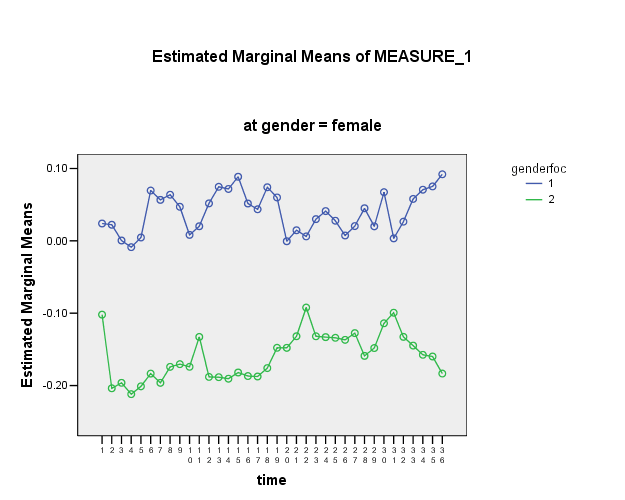 And, although it is a less pronounced effect, we found greater frown activity in male listeners during songs when female rappers talk about using men as sex objects green line) compared to songs where men are talking about their sexual proclivity (blue line):
 The other interesting finding was that there was not a difference in arousal level according to the lyrics. That doesn't mean there wasn't an effect, though. Males, regardless of the gender-focus of the lyrics, had more skin conductance responses during the songs than females.
Saturday, May 06, 2006
No official vote yet
I mentioned a few days ago that the senior departmental faculty were going to vote on my tenure case yesterday. Well, apparently they reminded themselves that they procedurally should NOT hold an official vote until they get a chance to read my outside-reviewer letters.
You see, as part of the tenure process, junior faculty and their departments come up with lists of distinguished faculty from across the world in (hopefully and usually) in the same area of research. These faculty agree to read and review the research publications of the tenure-track faculty member. They then write a letter critiquing the work and, basically, saying whether or not they think that the nominee should be tenured. In IU's case, in fact, the letter-writer is specifically asked something like 'if this person was going up for tenure at your institution, would he receive it?'
So, anyway, my chair, Walter Gantz and I have come up with a list of 12 distinguished faculty from across the country. This list has been approved by the College's Dean's Office. And now, Walter will send them a letter soliciting their help in my tenure case. If they agree, we will ship off photocopies of my research for them to read and critique. If they don't agree (because their too busy, most likely) then...well, let's hope they all agree!
The bottom line is, the senior faculty decided that it would be best to not hold a formal vote until these letters come in at the end of the summer.
It's a mental thing to not use this "more waiting" as a reason to get down or discouraged. There is nothing I should be doing accept continuing to do my research and teach my classes to the best of my ability.
Still, the waiting is hard to do.
You see, as part of the tenure process, junior faculty and their departments come up with lists of distinguished faculty from across the world in (hopefully and usually) in the same area of research. These faculty agree to read and review the research publications of the tenure-track faculty member. They then write a letter critiquing the work and, basically, saying whether or not they think that the nominee should be tenured. In IU's case, in fact, the letter-writer is specifically asked something like 'if this person was going up for tenure at your institution, would he receive it?'
So, anyway, my chair, Walter Gantz and I have come up with a list of 12 distinguished faculty from across the country. This list has been approved by the College's Dean's Office. And now, Walter will send them a letter soliciting their help in my tenure case. If they agree, we will ship off photocopies of my research for them to read and critique. If they don't agree (because their too busy, most likely) then...well, let's hope they all agree!
The bottom line is, the senior faculty decided that it would be best to not hold a formal vote until these letters come in at the end of the summer.
It's a mental thing to not use this "more waiting" as a reason to get down or discouraged. There is nothing I should be doing accept continuing to do my research and teach my classes to the best of my ability.
Still, the waiting is hard to do.
Tuesday, May 02, 2006
Tenure is scary
I've mentioned in earlier posts that the tenure process is beginning for me here at IU.
For those of you unfamiliar with what that means, I currently hold what's called a "tenure-track, probationary" position. Typically, that means that an Assistant Professor would have six years to work in their Department--developing their classroom teaching and establishing themselves as a developing expert in a certain area of research.
Then, after that six year probationary period, they submit a dossier containing (among other things) all their publications, conference papers, course syllabi, and examples of service such as journal article reviews--departmental committee work, and such. If you really want to read all that is entailed...click here.
For my case, because I spent 5 years on the faculty at the University of Alabama, I will be "going up" after only 3 years here in Bloomington.
And, the process begins for me in ernest this Friday. The first hurdle is for the senior faculty of my department to meet and discuss my record of research, teaching, and service. After that discussion...they vote.
Although I am confident of my record, when you get right down to THE VOTE (the first of many...at various levels upward to eventually the Board of Trustees), it's enough to make anyone a little anxious.
Here's an entertaining article with reader comments (interestingly, this link was forwarded to the Telecomm. faculty...myself included...by one of the senior faculty members who will meet to discuss me and vote on me this Friday.
For those of you unfamiliar with what that means, I currently hold what's called a "tenure-track, probationary" position. Typically, that means that an Assistant Professor would have six years to work in their Department--developing their classroom teaching and establishing themselves as a developing expert in a certain area of research.
Then, after that six year probationary period, they submit a dossier containing (among other things) all their publications, conference papers, course syllabi, and examples of service such as journal article reviews--departmental committee work, and such. If you really want to read all that is entailed...click here.
For my case, because I spent 5 years on the faculty at the University of Alabama, I will be "going up" after only 3 years here in Bloomington.
And, the process begins for me in ernest this Friday. The first hurdle is for the senior faculty of my department to meet and discuss my record of research, teaching, and service. After that discussion...they vote.
Although I am confident of my record, when you get right down to THE VOTE (the first of many...at various levels upward to eventually the Board of Trustees), it's enough to make anyone a little anxious.
Here's an entertaining article with reader comments (interestingly, this link was forwarded to the Telecomm. faculty...myself included...by one of the senior faculty members who will meet to discuss me and vote on me this Friday.
Monday, May 01, 2006
Like oil and water: Stern and Religious Broadcasters
It's finals week here at Inidiana University.
And, on top of it, there are a lot of research deadlines due.
So, things may be quiet from The Audio Prof for a while.
But, I'll try to point you in directions of interesting articles that I find every morning as I surf the web in preparation for work.
Here's one from several places, including the Baltimore Sun
Seems that due to faulty Sirius Sattelite receivers in cars--that turn them into momentary TRANSMITTERS at low FM band frequencies--cars that pass by these rogue transmitters hear the Sirius signal in their FM radio.
And..what is usually at the far left end of the FM band in most cities. Fundamental religious broadcasters...the audience for which is exactly those who would be most offended by Stern and his antics.
And, on top of it, there are a lot of research deadlines due.
So, things may be quiet from The Audio Prof for a while.
But, I'll try to point you in directions of interesting articles that I find every morning as I surf the web in preparation for work.
Here's one from several places, including the Baltimore Sun
Seems that due to faulty Sirius Sattelite receivers in cars--that turn them into momentary TRANSMITTERS at low FM band frequencies--cars that pass by these rogue transmitters hear the Sirius signal in their FM radio.
And..what is usually at the far left end of the FM band in most cities. Fundamental religious broadcasters...the audience for which is exactly those who would be most offended by Stern and his antics.
Subscribe to:
Posts (Atom)


 Posts
Posts


