Tuesday, June 28, 2005

Dr. Schwartz!!


Back in 1996 I was a graduate student here in Bloomington taking a class--something on research methods in the lab--that met in an old home that IU had bought for departmental use. One of the classmates at the time was Nancy Schwartz. She was a student in Instructional Systems Technology and we had a lot of good times learning how to measure audiences responses to different media.

Anyway, I went on to graduate in 1998 and then to Alabama. Nancy stayed here--eventually joining the IU Telecomm. faculty as a lecturer. She is an excellent teacher and working on up to three classes each semester with her extrodinary detail to prepping, instruction, etc., ate into time she could devote to finishing her dissertation.

She collected data quite awhile ago--physiological and memory data exploring the impact of animation on children's educational computer programs--but was not able to write the darn thing up.

Well, her clock was ticking. . .PhD candidates have only 7 years to complete the program.

But, I'm glad to announce that Nancy is now "Dr. Nancy Schwartz!"

Above is a picture of her (in the tiara!) with Dr. Julia Fox at a party we held to celebrate Nancy's accomplishment.

Congratulations, Dr. Schwartz!

Here we are


According to Blogger, I can now upload photos directly into the blog.
Well, let's try it.
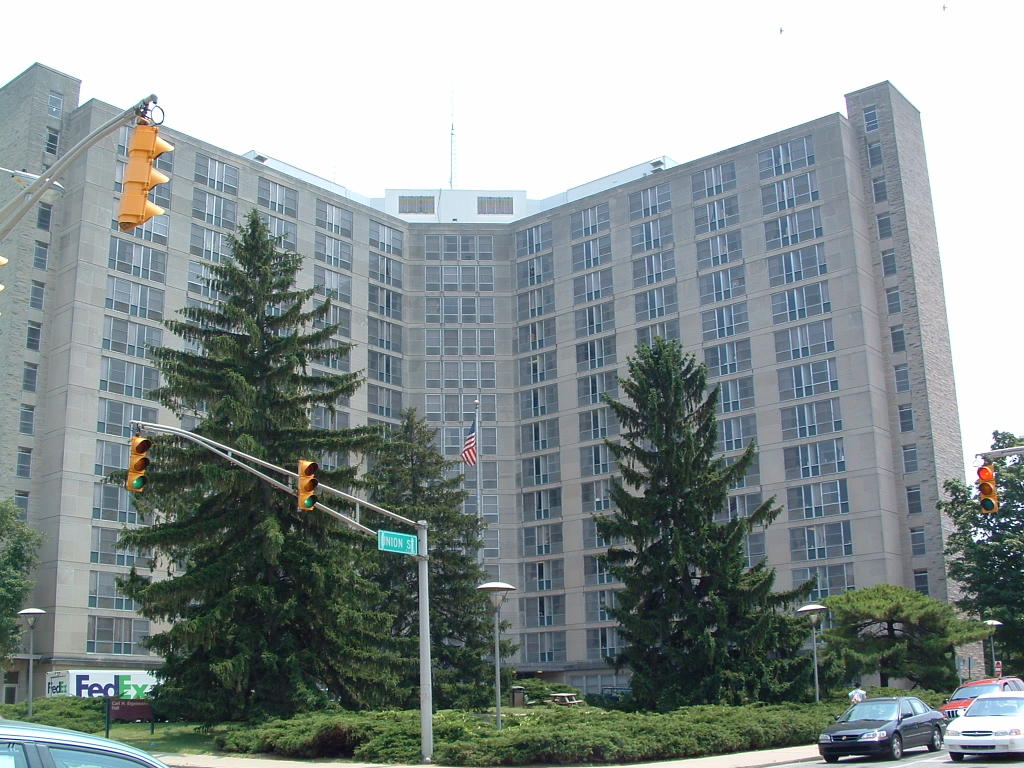
Here's a picture of Eigenmann Hall, the place where the ICR is located.

It's an interesting set up, actually. Eigenmann has traditionally been a dorm (the University would prefer the term 'residence hall') but as the need for administrative offices and research space has increased, the demand for dorm rooms has decreased--due to students wanting to live off campus, and probably a bunch of other reasons I'm now too old to understand.

We're on the 6th floor, west wing.
The North and East wings of most floors are still inhabited by undergrads, which makes for interesting times--nothing like coming in to work and having an undergrad come out of the men's bathroom in his bathrobe or towel!

Still, the space we have is very functional and there's plenty of it.

Monday, June 27, 2005

Good 'bosses'

In the academic field, those who serve in positions such as Department Chair or Department Head are often folks who--just like other professors--are interested in doing research and teaching. However, they also agree to serve their department and the field by being chair. They get a boost in pay. . .but in my opinion that doesn't compensate them nearly enough for the administrative junk they must deal with.

Anyway, my point is that, unlike the corporate world where one's BOSS usually has power over hiring & firing you. . .a department chair is really a peer who has agreed to serve.

Now, a chair certainly is important to the assistant professor because s/he can shelter them from other demands of the university life and give them time to focus on their research and teaching.

On Friday, I called the first Department Chair I ever worked for to wish him a happy birthday. His name's Loy Singleton and he was a VERY good chair. Not only did he shelter me from tons of administrivia during the 5 years I was at Alabama--allowing me to do my research--but he was generally interested in what I was doing. Even though it was far afield from his own interestes in new technology introduction.

I owe a lot to Loy, and really enjoyed catching up with him.
Like in any industry, I suppose, one of the joys of being in it for a long time is developing friendships with others who share your general interests.

Well, gotta get to work...

Tuesday, June 21, 2005

Should researchers market their ideas

Here's an intersting blog from Seth Godin:

Check it out

In it he says that:
"Marketing is not about trickery or even insincerity. It's about spreading ideas that you believe in, sharing ideas you're passionate about... and doing it with authenticity."

If that's the case, then I'm wondering if more academic researchers (okay, I'll stick to talking about those I'm most aware of--in the area of communication/media/etc.) shouldn't spend some time working on a little marketing 101.

Actually, that was the idea behind starting this blog and my website in the first place. Seemed to me tht a lot of relevant research was being done not only by me, but by others at major (and oftentimes "minor" universities that could directly benefit the media industries.

If you are an academic, then you are well aware of the old saw that we do research that gets published in then sits on dusty library shelves where no one reads it--let alone applies it to anything practical. Certainly, there are some reasons for this. First, the nature of writing the academic article makes it inaccessible to those who don't "speak the language" of research. Secondly, professors on the tenure-track are worried about focusing on other things (like publishing the next article!) and don't have the time to devote to creating press releases or trying to market their ideas.

But, I still contend that the web and other electronic outlets now make it easier than ever to market ourselves and be relevant to society at large.

Some organizations have tried to do this, such as the Association of Educators in Journalism and Mass Communication. Visit AEJMC and check out the "Research you Can Use" link. Unfortunately, this link still ends up in a rather boring pdf copy of press-releases developed and likely distributed mostly in the same old way.

Time to regroup

One of the things I did today was update my board. About 2 or 3 times a year I have to re--approach THE BIG WHITE BOARD. That's a write on/wipe off board I have in my office that I use to track the research work that I have going on. Here's a picture of a similar one I had in my office at the University of Alabama. I don't have a pciture of the current one, because I keep forgetting to bring my camera to the office with me.

It's interesting to look back at this old picture of "the board." This picture was taken about three years ago==and was part of my job talk at IU and Penn State. The theory behind the board is the same. . . always have something going at each stage of the research pipeline. I suppose it's telling of how you conceptualize the research process by how you would divide up the stages. You'll see in this picture that I have Future (a place to capture those ideas that strike you as a cool research question/hypothesis/area of interest that you'd like to pursue someday), Prep, Data Collection, Analysis, Write, Conference, and Under Review).

You'll also notice on this particular picture that my "Future" studies column was taken with the Command to Write! Write! Write!

That seems to be a difficulty for me.. . and the board has been getting particularly "right-heavy" with projects stacking up on the Right (write?) side.

And so, because of that fact, it is easy to get to feeling overwhelmed.
That's why an important task associated with updating the board is to change the colors of things you have completed.

Remember in Homicide when the murder was first discovered and the name of the victim was written on the board in one color ink. Then, when it was finally solved, you saw the extreme close up of the hand erasing the name and REWRITING it in a different color? No sense in having all the work of the investigators immediately forgotten by erasing the name.

Same idea.

Today, I updated the board.

[oh, and by the way, if anyone reading this knows which color was the open case and which the closed case in Homicide please let me know].

Friday, June 17, 2005

Another Communication Professor

I'm pleased to report that Dr. Sam Bradley successfully defended his dissertation this afternoon. It was a quite enjoyable defense, actually. And the only one I've ever been at that had an audience in attendance. Although most American universities have their dissertation defenses open to the public--I would say that (at least within Communication departments) the only people who are there are the candidate and the committee of professors--it's usually only about five people.

Today, of course, the committee was there:
Annie Lang, the chair
Mike Gasser, the chair from cognitive science (it was actually a dual PhD that Sam received).
Julia Fox
Erik Bucy
and Me.

Well, today there were six other people in the room. A buch of grad students. . .even Sam's wife. Rather than making it uncomfortable, however, I hardly knew they were there. That is, except when Sam would refer to one of them in his answers--likely trying to remind us that there were 'others' in the room in order to keep the professors from getting too nasty. And, of course, it never did. It was a very well done study that utilized a startle response--a physiological response that is hard-wired into the human (and other) cognitive systems to act as a processing interrupt whenever potentially dangerous stuff comes our way. It's created in the lab by playing a short 50 milisecond burst of white noise (100 Hz) through headphones. Trust me this blast is loud and it makes you startle!! The measure is usually done by placing electrodes just below your eye and measuring how large your blink is in response to the startle proble.

Another important concept to understand re: Bradley's dissertation is the orienting response. This is a more common response in the human system, but one we are much less aware of. It's a response that happens whenever something new enters the sesnory field. It's also known as the "what is it" response. I talk about it a little bit in my posting on May 20. Anyway, whenver something new comes into your sensory field, your cognitive system responds in a predictable way--heart rate slows down for about 6 seconds, skin conductance in your palms increase, alpha waves in your brain are supressed--all indicative of cognitive resources being allocated to processing what's just come along. . . remember, it's the "What is it" response.

So, what does this have to do with startles? Turns out that decades ago, physiologists learned that if you do something to make a person have an orienting resonse just prior to sending that startle probe of white noise. . .the blinks that result will be substantially reduced. This orienting just prior to the startle probe is called a 'pre-pulse.'

Now, what Sam did was take past research that has show that cuts (changes from one scene to another) in television messages cause an orienting response in viewers and draw the logical inference that they woudl therefore act as a a pre-pulse for startle probes he sent to the viewer while they watched. He predicted that this prepulse would cause inhibition of the startle response while viewers watched episodes of ER.. ..turns out that they don't. And, in fact, they cause the startle to increase. Exactly the opposite from what happens in startle research that uses 6 second exposures to emotional still pictures.

I'm certainly not doing the study much justice writing about it at 10:30 at night. And I'd encourage you to contact Sam

From one type of teaching to another

Last day of summer school was yesterday.
This class of students was particularly special to me. . .don't quite know why.
Sungkyoung, one of my grad students, suggested that it may be because the class roster was so small. I think she's right. Knowing each student by name likely makes a big difference. That was possible with 20 students but not with the typical 75.

So, now I transition to the stack of grading that remains from the extra credit in the class and such.

Plus, I also need to move on to the dissertation and thesis defenses that are waiting in the wings. Today begins with Sam Bradley. Then it's Yongkuk Chung on Monday.

Wednesday, June 15, 2005

Summer school!!!

Well, summer session 1 is almost over. Today we'll meet for course evals and--although I had a lecture scheduled I think that the class (me included) are pretty burned out. So, I'll just make a few comments about XM & Sirius, podcasting, and the effect it's having on the broadcast industry with stations like Kyou.

Another semester of teaching programming comes to an end and I'm stuck with the feeling that all three major topic (tv, cable, and radio) but particularly radio has gotten short-changed in terms of the time devoted to it. I'm toying with the idea of suggesting a course that is strictly on the radio industry. Someday, maybe.

Just read an interesting story at FMQB that said the Jack/Bob/whatever format is having high cume but not high TSL. That seems contrary to what I'd expect. Could it be that people find the format of 'playing whatever we want' a curiosity but in the end disconcerting and disturbing? Seems like I love listening to MY ipod, but I may not want to borrow YOURS.

Thursday, June 09, 2005

New Blog Sightings

Okay, so I'm trying to understand how this whole thing works. How can I find blog about things I'm interested in. When you go to weblogs.com, it turns out that most of the updates seem to be nothing but ads.

But, I recently googled soemthing like "blogs about radio" and found this site:

http://www.radiomarketingnexus.com/

Seems to be right up my alley.
In fact, I noticed that it was commented on by Mike Ellis, a guy who usesd to be my boss at KZZU back in the late 80s. Now, he's at a place called the broadcast group. But, the fact that he's found this site and liked it makes me think it must be good.

Of course, now I'm too tired to read it. But tomorrow. . .

Emotion website

Okay, so my wife is in fixing dinner and I'm feeling guilty cause I'm out on our porch blogging.

But, I came across a great website earlier this week (thanks to Kim Kommando. . .it wasn't one of her "Cool Sites of the Day" but it was linked on one of them.

Anyway, one of the things I'm interested in as a researcher is emotion. . .particularly how emotional reaction to media (audio?) impacts how you process it.

But check out Eric. . .some guy who acts out emotions via a webcam.

http://www.emotioneric.com/

Very funny. . . but also reminiscent of Eckman's serious work on emotional expression in faces.

Tuesday, June 07, 2005

A great picture from ICA

In one of the cool things that happened at ICA was getting together with old friends and colleagues. There was a session where I had either my own work, work from my students at IU, or work from my former students at Bama. Afterwards we went out for dinner and had a picture taken.

In the very back row is Fei (who I mistakenly called Edgar--another comm. scholar from Korea--when I saw him in NYC. Fei is currently teaching advertising at Mississippi State, I believe. A bama grad.

Then it's Brian Wilson, a masters student at IU and my RA this past semester. He worked closely with me on the "double-units" radio clutter experiment, which I may tell you about sometime.

The next two are a couple, actually. It's Francesca Dillman-Carpentier--a student I met at bama. I actually served on her dissertation committee, which was chaired by Dolf Zillmann. Francesca's been doing a post-doc in a social psych lab at Arizona State for the last. . . geez I guess it's been three years. Next year she'll join the telecomm. faculty at UNC. Next to her is her husband Chris. A very nice guy who is working on his grad degree in computer science.

The middle row is Courtney Carpenter--a phd student at bama. I was on her masters committee in the APR department. Glad to see she continued on with the doctorate.

The next is Shuhua Zhou, who I met when we were both grad students at IU. He was in journalism , but we both worked together in the lab. Then, a year after I joined the Bama faculty, so did he. We worked together down there for 4 years, I guess. I miss him very much and always look forward to ICA so that I can talk with him again.

Aimee Edison is the one with the spiky hair. She was a masters student of mine at bama, and I we have done work together on the effect of advertising clutter in radio. Right as I was deciding to leave UA to go back to bloomington, she was trying to decide whether to stay at bama for her PhD or go to Michigan State. Only days after telling me that she had decided to stay in Tuscaloosa I made my decision to to back to IU. Made me sad. Now, she tells me that she's getting 2! doctorates at bama--one in Communication and another in Psych.

Then a lineup of three grad students from the ICR-lab--Narine, who has been working closely with Annie

Monday, June 06, 2005

Lab meeting--

Each week we hold a lab meeting here at the ICR lab. I'm sitting here wondering whether it would be good to blog during the meeting. That way people get a sense for how we move things along.

The lab works on many studies simultaneously--some are grant funded (those are the important ones!) and many others are ones that faculty and/or grad students are working on. Each week we go through a list of all the studies to see how they are going.

This is a way to make sure that everything keeps moving forward. So, although everyone in the room right now would love to be taking a rest after ICA--meeting and being diligent about thinking about what's next--is a way to keep up momentum.

Oh, by the way, I know that I haven't posted much on ICA by the way. I'm hoping to be able to do that tonight. Or tomorrow night.

I've been lax on blogging because I've been working on getting the latest version of my clutter study ready to go. Speaking of which, the reason why I've got to get my act together is that we have talked several professors teaching this summer into letting us recruit students from their class. And now, since they have all said they would allow us to do it, now we need to bring them studies for their students.

And, partially because I'm the guy to cajoled them into agreeing (as the ICR Director) to have us come into their class--I have to go in.

Well, someone just asked me "do you usually blog during lab meetings?" My sercret may soon be out.

So that's it for now.